After checkmating the powerful North Atlantic Treaty Organization (NATO) through veiled threats of nuclear weapons, President Vladimir Putin is now rapidly losing support even in Russia, after his air force reportedly hit a maternity hospital earlier this week. Western sanctions are in place. The relatively small Ukrainian army and brave civilians are putting up a fierce fight. Is the Russian Goliath losing the battle on the ground? Is Ukraine going to be the new Afghanistan? Defence strategists General Syed Ata Hasnain and General Shokin Chauhan, speak to Padma Rao Sundarji for Times Online on Russia’s military strategy in Ukraine, India’s dependence on Russian weaponry and – Russia’s growing closeness to Pakistan and China.Q: The Russian army has 900,000 troops, more than 2 million reservists, but it sent only about 150,000 soldiers – a fraction of its total strength – into Ukraine. You have both worked and trained with the Russian army and know it intimately. A small start, a gradual build-up: is this routine military strategy before more firepower is unleashed? Is this a lull before a storm?HASNAIN: Any war strategy has to be based on certain assessments and those are based on intelligence. Ukraine was part of the former Soviet Union. The Russians know it like the back of their hand. They know the cities, the people, the leadership, the military, everything. Brinkmanship was obviously not the issue when President
Putin launched the war, so he proved me wrong. However, I was clear even at that time, that Putin would not go whole hog, because Russia is not an island unto itself. It has to live with the international community. So, Putin was calibrating right in the beginning. And it made sense to bring in a limited number of troops - between 130-150000 - and combat aircraft. The Ukrainian air force is not much to write home about – they have about 700 aircraft, most of which are off-road. The Russians have encircled Ukraine including the southern areas. This has virtually blockaded Ukraine like a landlocked state. Port cities like Odessa have been targeted. This is where there is precision engineering, high-quality technology. And of course, wheat-rich Ukraine is the granary of Europe.
The intent was to squeeze the economy of Ukraine. So, it’s not just the military application alone, diverse things are happening.
CHAUHAN : Planning a war is based on a political objective. What kind of objective and how quickly do they want to reach it? There are about 60 -70000 Russian troops in Belarus which is the northern thrust. In the central sector, another 60-70,000-odd troops are moving towards Kharkiv, the second largest city. And the third thrust would also be of around that number in the south: to link up Donetsk and Luhansk and target the Sea of Azov. to cut off Ukraine’s access to it. Crimea is already theirs. And there’s been some action towards Odessa. So, if you add all these up, you get a maximum total of probably 180-200,000 troops, which includes reserves. When you are planning war strategy, ordinarily the reserves would be about 40% of your main force. The main force would probably be divided into an initial reconnaissance force with a reconnaissance-in-force - maybe 20% -10% - of what you have, with a larger thrust coming, when the reconnaissance-in-force has done its job. You never launch the main force in battle, till you have done the reconnaissance. Between Feb 24-28, Putin launched these reconnaissance-in-force troops, to see where the Ukrainian army is in strength, where they could bypass them and - to see how quickly they could reach their objective.
Is Russia losing in Ukraine? Indian army generals respond
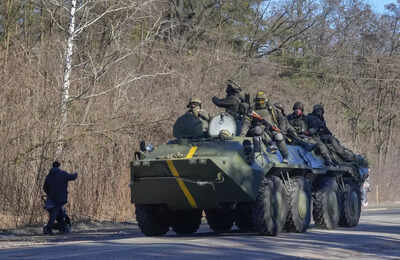
Sorry, I disagree completely. If someone is making these observations from the western world and unless he’s got tremendous evidence to show, this is all fake news, propaganda, psychological warfare, to motivate Ukrainian armed forces to think they are fighting against a non-professional organization, and, to demotivate and create a diluted image of the Russian armed forces. Food, water, fuel: these are three things which a professional army will never compromise on. I don’t think that the Russian military system has deteriorated to such an extent that its generals cannot cater even for the logistics of their forces. While carrying out the preliminary break-in operation, Putin did not cater for creating air superiority over this region. That would have enabled his ground forces to go in very, very comfortably. He’s seeking to do even today, but not succeeding. And I believe that even now, he is calibrating, as far as air power is concerned. But on the ground, he seems hellbent on causing a lot of destruction in select cities, to send home a message to the Ukrainian people, leadership and armed forces, that much more could follow. This is a form of psychological warfare. When it comes to deploying 130000 odd men on the ground, you always keep your reserves. That is an essential aspect of fighting a war. I am not in agreement with the Russian strategy at all. However, they are right in launching their operations all over, including the maritime zone. From the strategic point of view, that’s the correct thing to do because it keeps your adversary guessing. Where they are wrong is the very infrequent, low-density use of air power, which in today’s modern battlefield, is very important. Anyone who knows military strategy knows that the first casualty in war is your plan. You had plan A, but it is redundant the moment you cross an international border. So, you’ve now got to look at Plan B. For that, you may require more reserves, more forces. So, reserves is a very important aspect, which somehow, the Russians don’t seem to have catered for. If they are really looking for the centre of gravity, which is Kyiv, they should have gone whole hog for it by now. This 65-km long column of armoured vehicles, tanks, etc. lined up north of Kyiv, has been waiting there forever. What is it waiting for? To show faces to the Ukrainians and hope they will capitulate? By now, Kyiv should have been completely isolated. The squeezing of Kyiv would have started, street battles would have commenced, and all these tanks would have driven in by now.
There seems to be some communication gap between the Russian structure and the leadership. Putin is hugely isolated, hit by Covid and psychologically affected. There may be a trust deficit with his own higher military leadership. Therefore, his decisions may not be very rational. Experienced friends from the Indian Air Force tell me that a deeper look into the Russian air force reveals that all is not well there. The availability of spare parts is not that rosy. Russian pilots are putting in very limited training, unlike our world-class pilots. Be it fuel requirements or logistics backing like repairs and maintenance – which the air force requires a lot of, -something is lacking. So, obviously the frontline elements of the air force can only do that much, if there’s no backup. In many cases they have also been shot down by the S 300 systems. Yesterday, we saw a Stinger missile bring down a low-flying helicopter. So, there is attrition too – and no easy solutions.
CHAUHAN: Kyiv is around 50 km in radius, including its outskirts. To cut off Kyiv from all sides requires substantial effort. I don’t believe the Russian army is stupid enough to enter and fight in the main cities. I feel that Russia’s main force will take its time isolating Kyiv. That’s the reason why they started moving further northwards and westwards, after reaching about 25-30 km from Kyiv, instead of going in. So what’s their military objective? They’ve kept the air force involvement fairly low because they don’t want to do too much infrastructure damage. So, they have gone into a battle without using their main capabilities – their fire power, missiles, artillery, and to a large extent, their strategic air force. They’ve been going very carefully. From March 4 onwards, Russia said it would provide safe corridors, a sense of ceasefire, a second logistic pause, and a chance. Because Putin also wants to show that he is a reasonable man. He may not be reasonable, but he still wants to show the world that. Finally, please note: it is still only the first week of March. It’s winter in Russia.It’s snowing there. It’s difficult to move mechanized columns, tanks cross-country, so they have to move along roads. Why a winter campaign? To prevent anyone else from coming in.So, Putin has chosen these issues correctly and at a time when nobody else can come in. We fought the Indo-Pakistan war of 1971 in winter when our passes close, and Chinese help would not be available to the Pakistanis. And we finished the war within that winter.From the 3rd of December to the 17th of December. So also, Putin has planned this war during winter knowing that very very few other countries have the capability to operate their mechanized columns in winter. And he’s going slow because there’s still another winter month left. When you’re talking of logistics, you’re looking at all these issues. You’re looking at a main force, air force and artillery which haven’t been used yet. Why not? Because they don’t want to alienate and isolate the people. So when these think-tanks you quote criticize something, why aren’t they talking about the weather and the snow?
Q: NATO has the most sophisticated war machinery in the world. Even its old weapons of the Cold War era have either been retired, or modernized thoroughly. It has trained and equipped the Ukrainian army with many modern weapons and more are on their way. But Russia’s weapons are mostly inherited from the Soviet Union. Is that old, refurbished weaponry now proving to be a hindrance to the Russians in Ukraine?HASNAIN : As a composite fighting force, the efficiency of the Russian armed forces is compromised to a large extent. I love to talk about 1969, when the Russians engaged China on the Ussuri river (that runs through Russia and China). They fired so much artillery that they wiped out the complete deployment of the PLA there. That’s the way the Russians were known to fight. The West has invested tremendously in new technologies. One of the major achievements of the Russians, of course, is the S -400, the world’s finest air defence system. But besides that, the Russians are certainly slightly behind countries like France, Sweden, Italy, Germany, the United States and the UK. Some of the West’s lower-grade weapons have come to Ukraine and more are being sent now. I’m not sure how, but a lot of anti-tank missiles like the Javelin have come in. as has the Stinger, which dates back to the Afghan war of the eighties but remains efficient. So, this is, to an extent, also a war between generations of weapons.
CHAUHAN: Not really. Let’s look at the Russian armour. They are using the upgraded T 72, which is their main battle tank (as it is for the Indian army). It’s a very versatile, powerful tank. They also have T 90s. We haven’t seen those in battle yet, they are probably with the reserve force. They have made use of the multi barrel rocket launchers, and their air defence weapons. I don’t see any inferiority. This is the way they have fought, practised, and this is the way any professional army would carry out a campaign. Basing one’s perception on the media of the western world, which is clearly doing propaganda, is a mistake.
Q: In a general analysis of the Russian armed forces, the Stockholm International Peace Research Institute (SIPRI) notes that the ‘morale, military preparedness, combat experience, doctrine and organization” of the Russians are high. But world opinion is squarely pitched against Russia’s invasion of Ukraine. Ukrainian civilians are making it clear to the troops on the ground that they are unwanted intruders. Thousands of Russians are protesting the invasion too. Surely this anger and resistance is bound to dent that legendary Russian military swag?HASNAIN: The Russians are reputed, and many of our officers keep going back there. We intermingle with them and study their military institutions. I don’t think any of us have come back with the impression that the Russians are inefficient. I tend to agree with SIPRI but the question is that of application. Our officers also swear by the efficiency of the Russian army but, this seems to be a rather strange phenomenon we are witnessing here in Ukraine. Quite evidently, the war does not have the backing of the Russian people. And what is an army? It is only a reflection of society. There’s a human element to it. The motivation, drive, nationalism etc. of the troops may be slightly compromised because the build-up has not really taken place efficiently. Even the Russian armed forces seem surprised by the decisions taken. And it’s not good to keep your own armed forces guessing. Let’s also accept that the Ukrainians are proving to be good fighters. They are motivated for their homeland, they’ve got good leadership and everyone – film personalities, sportsmen – is coming out to fight. A nation in this mood is difficult to defeat. In the theory of war, many times one talks about a thing known as ‘just war’. Is this a 'just' war? The people will always be behind their leader and support him if there’s a just war. If it’s something they perceive as good for the nation. But this invasion of Ukraine doesn’t seem to be anyone’s war, except Putin’s war.
CHAUHAN: Let’s talk about the insurgency that people expect the Ukrainians to launch. It goes back to my point if the Russians are using sensible information warfare techniques, and dealing with the population of Ukraine, telling them that they are a part of them, and given that Ukraine has a pro-Russian population of almost 20-30%, insurgency may not be that effective. East of the Dnieper river, motivating the mostly Russian-speaking people there, may not be a problem, it is the people west of the river who may pose one. I am certain that the Russians have planned for eventualities. Regime change can’t happen on its own, they may have to force it. As the Russians close in further, this would be the uppermost on their minds. They would use a lot of time trying to convert the population of Ukraine, especially in the cities that they have captured. And they would not make the same mistake the Americans made in Iraq, by demobilizing the Iraqi army and creating a whole greater force of well-trained insurgency. But yes, there are clearly all kinds of misgivings.
Q: Global sanctions are in place against Russia. Its earnings from oil and gas exports will plummet. Its military spending will plunge. The problem of spare parts for its weaponry will grow worse. India bought Dassault Rafale fighter jets from France and other weaponry from various countries. But, India still relies chiefly on Russian defence equipment. This is one of the reasons India has abstained from censuring Russia at least five times. Is this dependency misplaced? High time for India to start shopping elsewhere?HASNAIN : Absolutely correct. We should be shopping elsewhere. The only thing is, we’ve got generations of weapons of the Soviet Russian lineage. Spare parts, particularly for the airforce are guaranteed, because of that relationship. If this problem with China were not there, if the Line of Actual Control (LaC) were quiet, if the April 2020 incursions had not taken place, I can assure you the situation would have been very different today. The moment India steps across the line and goes into the western fold, the Russians would also step across and get into the Chinese fold.They are already in the Chinese fold in other contexts, but then it would be in the Indian context too. And a Russia-China partnership with Pakistan on the western front ? Remember, Pakistan is not an irrelevant state for Russia, especially in light of the new great game which is going on in Central Asia, Afghanistan, Pakistan, Iran, this whole region. Because of this Ukraine war, we seem to have forgotten all about the ideological battles of political Islam, the gravitation of terrorists into northern Afghanistan, and their potential of stepping into Central Asia. These are issues which have receded into the background. The Russians want Pakistan on their side too. They don’t want Pakistan meddling and projecting political Islam into Central Asia, which 72 million Muslims inhabit, 22 million of whom are in Xinjiang in China. China doesn’t want that either so there’s a convergence there. And we in India certainly don’t want to act as the triggers for that. We want to be equidistant and would like the Russians on our side. Yes, we are in the process of developing our indigenous capability. Atmanirbharta (self-reliance) is the best thing that could have ever happened in India. But it commenced only 2-3 years ago. There’s no magic wand, it can’t happen overnight, it will take us 15-20 years. Till then we are dependent on Russia for most of this equipment, because we can’t rely completely on the West. The time has come for India to start weaning itself off Russia. We made great inroads into Israel but Israel has limited capacity, it can’t meet all our requirements, which are much, much higher. We can buy off the shelf – from Germany, France, or Sweden etc. But again, the guarantee of spares and supply chains will remain most important to us.
CHAUHAN: That’s a question which we should have been asked 50 years ago. We are in it now. So there’s no question of shopping elsewhere. We trained on these weapons systems. They are very good, extremely hardy and we are very comfortable with this equipment. Further, Russian support to us during the Indo-Pak and China wars and political backing too, have been considerable. We bought 36 Dassault Rafales. But we have 36 squadrons in our airforce. Seventy percent of our airplanes are still very much Russian, MIGs are our mainstay. Be it the airforce or artillery or the armoured vehicle – the T-72 and T-90 are our main battle tanks – these are our main battle tanks, they have served us well. We can’t get rid of them. Remember also, Russians helped us during those periods when we weren’t getting any weaponry from anyone else. I’ve been the Commander, 1 Corps and I can tell you that the T90s are fabulous battle tanks.. You can’t change weapons systems midstream. And you can’t have too many weapons systems either, because each different weapons system has a different logistical requirement. We are acquiring different submarines because there’s a technology change. But we have leased a Russian nuclear submarine, we have diesel submarines, we are moving towards more silent submarines, submarines which have greater range. We are doing that and the Russians are helping us out. We’re also manufacturing our own. In time and given the Atmanirbhar (self-reliance) policy, this question simply will not arise, because we’ll be able to do it all on our own.
Q: During our last conversation, you noted that Russia disabled a NATO military response through the irresponsible use of a veiled nuclear threat. But though NATO is rendered unable to even provide the air shield that Ukrainians need, sophisticated weapons are being sent to Ukraine. Analysts worry that illegal arms bazars may be flourishing. Meanwhile, mercenaries from Europe and the States are advertising their availability to fight in Ukraine. Will Russia dig its heels in for the long haul? Is Ukraine going to be the new Afghanistan?CHAUHAN: When you’re using a preponderance of forces, good equipment and - your soldiers are professional, you will win. It’ll take time. War is uncertain at best. The morale of the people of Ukraine is not known to us. We have not factored that in as an option. What the Ukrainians feel about their president and whether they will themselves feel it is time to do a regime change is something that is not known to us. As the Russians close in further, this would be the uppermost on their minds. They will also try to convert the population of Ukraine, especially in the cities. And they will try not to make the same mistake the Americans made in Iraq, by demobilizing the Iraqi army and creating a whole greater force of well-trained insurgency. Also remember: the Ukrainian army has not rebelled against their president
Volodymyr Zelensky. Yet. If that hasn’t happened, the Russians may be in for the long haul.
HASNAIN: This war can predictably go on forever. In the heart of Europe, that’s a very, very dangerous thing.